DTF Printhead Care: A Daily, Weekly and Monthly Routine
Most DTF printhead maintenance advice is a list of tasks with no order to it. In practice a head fails for one of three reasons: ink dried in the nozzles while the machine stood idle, the capping station stopped sealing, or debris was wiped across the nozzle plate. Each has a routine that prevents it.
Why Printheads Fail When the Machine Is Idle
A printhead is a set of very small channels filled with pigment ink. Water leaves the ink at the nozzle opening whenever the head is exposed to air, and pigment settles out of suspension when the ink stops moving. The result is a partial clog that shows first as a gap in a nozzle check, then as a visible line three jobs later.
White ink is the worst offender because of its pigment load, which is why machines with a white ink circulation kit hold a clean nozzle check longer between jobs. Circulation slows settling. It does not replace cleaning. A machine that runs daily stays cleaner than one that runs twice a week.
Maintenance is not proportional to output. A shop printing four hours a day needs a stricter routine than one printing eight, because the idle gaps are longer.
The Daily Routine: Ten Minutes at the End of the Shift
Do this at the end of the working day, not the start. Cleaning before an idle period is worth more than cleaning after it, because the ink has not had eight hours to dry on the plate.
- Run a nozzle check and note missing segments in a log, so a trend is visible before a job fails.
- Wipe the nozzle plate with a lint-free swab and cleaning fluid, one direction, without pressing hard.
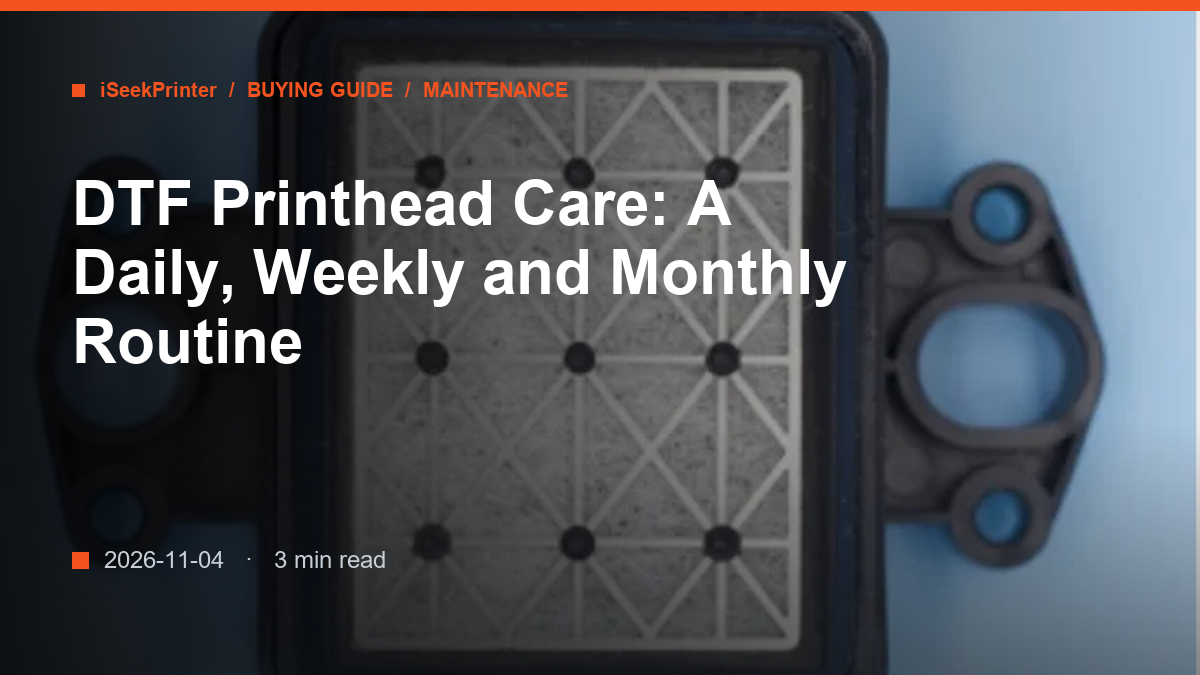
- Check that the capping station seals: no gap, no dried ink on the lip.
- Check or empty the waste ink bottle; a full bottle backs ink into the cap overnight.
- Agitate the white ink cartridge or bag, then run a short circulation cycle.
- Leave the carriage capped. An uncapped head overnight is the usual cause of a Monday morning clog.
The Weekly Routine: Caps, Wipers and Waste Ink
Once a week, take the parts that touch the head off the machine and either clean them properly or replace them.
- Remove the capping station and flush it until the felt and ink ports run clear.
- Clean or replace the wiper blade; a wiper with a dried ink ridge scores the nozzle plate on every pass.
- Clean the carriage surround and the area under the cap, where mist collects and dries into a crust.
- Check the ink supply: dampers partly filled, no air bubbles, no dried ink at the tubing joints.
- Inspect the capping station spring and travel. A cap that no longer seals is a replacement, not a repair.
A capping station is a wear part, and a cheap one beside a printhead. That is the whole argument for replacing it at the first sign of a poor seal.
The Monthly Routine: Dampers, Tubing and the Encoder Strip
Monthly work covers the parts you cannot see during a print. Inspect the dampers for partial blockage, check the tubing for sediment at the bends, and clean the encoder strip with a dry lint-free cloth. A contaminated strip causes banding and misplaced dots that look exactly like head failure.
This is also the point to read the nozzle check log rather than only write in it. If the same segment disappears after every cleaning, the cause is upstream: a damper, a failing head board, or a head at the end of its life.
Storage: What to Do Before a Quiet Week
If the machine will stand for more than a few days, cap it, leave the ink system full rather than empty, and keep the room inside the ambient range it expects. Ink, film and powder all behave better between 18 and 28 °C and 40 to 65 % relative humidity. A cold workshop in winter causes more clogs than a busy week.
Before restarting, run a cleaning cycle, a nozzle check, then a small test print on film you were going to discard.
When to Clean, When to Replace
Cleaning restores a head when the fault is ink residue. It does not restore a delaminated nozzle plate, a cracked housing or a failed actuator. The symptoms are a nozzle that stays dead across every cycle, a head that drops out once it warms up, or a board error that returns after a restart.
Rule of thumb: if three consecutive cleaning cycles do not recover a nozzle, stop cleaning. Further pressure cleaning damages the plate, and the head was most likely at the end of its life before the clog appeared.
Keep one spare printhead on the shelf for the machine you run most, and record when it was installed. A head that fails with a spare on the shelf is an hour of work.
Comparing machines or planning a production line? Send us your output figures and we will recommend a configuration and quote it.
FAQ
How often should a DTF printhead be cleaned?
A nozzle check and capping station wipe every working day, a full cap and wiper clean weekly, and a damper and tubing inspection monthly. Consistency matters more than depth.
Can a clogged DTF printhead be repaired?
Sometimes. Ink residue usually clears with soaking and a normal cleaning cycle. A delaminated nozzle plate, a cracked housing or a failed actuator cannot be repaired, and the head has to be replaced.
Does white ink need different care?
Yes. White ink carries a heavier pigment load and settles faster, so it needs daily agitation and, where the machine has one, a circulation cycle before printing. It also benefits from being printed every day rather than left standing in the lines.