Setting Up a DTF Shop: Space, Power and Workflow
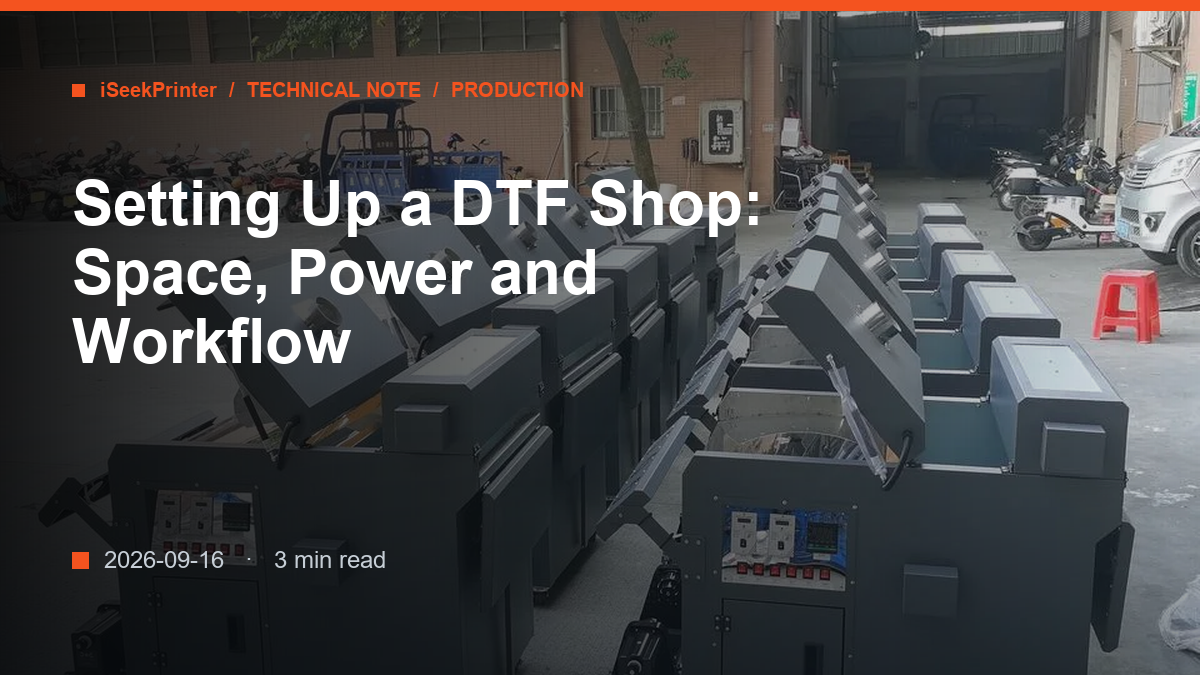
A DTF shop fails on logistics more often than on printing. The machine arrives, prints well, and then the workflow around it turns out to be the bottleneck: wet film queues for the shaker, the press sits on the far side of the room, and the only window is behind the printer. These decisions are cheap before installation and expensive afterwards.
Space: Machine, Bench and Drying Lane
Measure the machine footprint and add clearance on all four sides. You need to reach the back for maintenance, not just to unpack the crate. A1 machines are substantially longer than A3 and need a bench of comparable width in front for film handling.
- Printer footprint plus at least a metre of access on the service side.
- A flat bench at the printer exit for inspecting wet film; wet film must not be stacked or folded.
- Shaker and curing tunnel downstream of the printer, in the direction the film travels.
- Heat press within a few steps of the shaker, so cured transfers do not cross the room.
- A separate surface for finished garments to cool flat before packing.
Keep the wet film path short and straight. Every extra metre between printer and shaker is a place where film can be knocked, stretched or contaminated.
Power and Voltage
A setup draws power in three places: the printer, the curing tunnel and the heat press. The tunnel usually draws the most, and it draws continuously, which matters more than the printer's rating. Confirm the supply for the whole setup, not only for the machine.
Voltage is configured at the factory: machines ship in 110V or 220V with the plug type used in the destination market. Check what your premises actually supply before ordering, and give the tunnel its own circuit rather than sharing one with the press.
Ventilation and Heat
Curing powder produces heat and airborne particles, and a small room with a tunnel running all day becomes both hot and dusty. Extract at the tunnel rather than relying on an open window. Keep the workroom between 18 and 28 °C at 40 to 65 % relative humidity, and keep ink and film out of the extraction path.
Dust is the quieter problem. Powder that escapes the shaker settles on film, on the platen and inside the printer, and a dusty room shows up later as mottled transfers.
Consumable Storage
Film, powder and ink all degrade in the wrong conditions. Store film upright and sealed, away from direct heat and sunlight, keep powder sealed and dry, and keep ink at a stable room temperature rather than in a cold store. Rotate stock so older rolls go first, and label each roll with its peel type, cold or hot, because the two look identical once the packaging is open.
Workflow: The Order Jobs Move In
- Receive the artwork and confirm size, colour count and garment.
- Impose and print on film, with the white layer set for the garment colour.
- Powder, shake off the excess, and cure.
- Press the transfer, peel according to the film, and cool flat.
- Inspect against the wash-test standard you set for that fabric.
- Pack with the job sheet, and record the cure settings used.
Write this sequence on the wall. In a small shop the printer operator is often also the press operator, and a sequence that lives in one person's head changes the moment someone is off sick.
Comparing machines or planning a production line? Send us your output figures and we will recommend a configuration and quote it.
FAQ
How much space does an A1 DTF printer need?
More than the machine footprint: allow access on the service side, a bench for wet film, and room for the shaker and curing tunnel downstream. The path from printer to tunnel should be short and straight.
Can a DTF printer run on a normal mains supply?
The printer itself usually can. The curing tunnel and heat press are heavier loads and are better on their own circuits. Machines are configured for 110V or 220V before shipment, so confirm your supply first.
Do I need extraction for a DTF setup?
Yes. Curing powder produces heat and airborne particles, and a tunnel running all day will heat and dust a small room. Extract at the tunnel and keep film and ink away from the extraction path.