DTF vs DTG vs Screen Printing: Cost and Run Length
Choosing between DTF, DTG and screen printing is usually framed as a quality argument. It is more often a question of run length and fabric. Each process carries a cost structure that suits a particular order size, and most growing shops end up running two of the three rather than picking one.
Run Length Decides More Than Process
Screen printing carries a setup cost per colour per design: screens, exposure, registration and press time. That cost is fixed, so the price per piece falls steeply as the run grows. For short runs it is hard to justify. For long runs it is usually the cheapest option per garment.
DTG and DTF have almost no setup cost per design. You send a file and print. Cost per piece stays roughly flat whether you print one or fifty, which makes both the practical answer for one-offs, samples, names and numbers, and short runs that may never repeat.
The crossover between screen and digital depends on colour count, garment and local labour rate, so work it out with your own numbers rather than adopting a figure from a brochure.
Fabric and Colour: Where Each Process Wins
- Cotton in light colours: DTG gives the softest hand and the most photographic result.
- Cotton in dark colours: DTG needs pre-treatment and a white underbase; DTF does not.
- Polyester and blends: DTF holds colour and detail where DTG struggles with dye migration.
- Stretch fabrics: a correctly cured DTF transfer follows the fabric better than a heavy screen print.
- Large flat areas of one colour: screen printing is still the most economical and the most durable.
Dye migration is the specific problem on polyester. Disperse dye in the fabric rises into the printed layer during curing or pressing, shifting the colour days later. DTF with a suitable white layer manages this better than a thin DTG print, but it is a film and temperature question rather than a printer feature.
Cost Structure: Setup Versus Consumables
Screen printing costs are front-loaded. You pay for screens before the first garment is printed, and that money is gone if the design changes. DTG costs sit in the machine, the pre-treatment and the ink. DTF costs sit in consumables, meaning film, powder and ink, plus the labour of powdering and pressing, which is the part buyers underestimate.
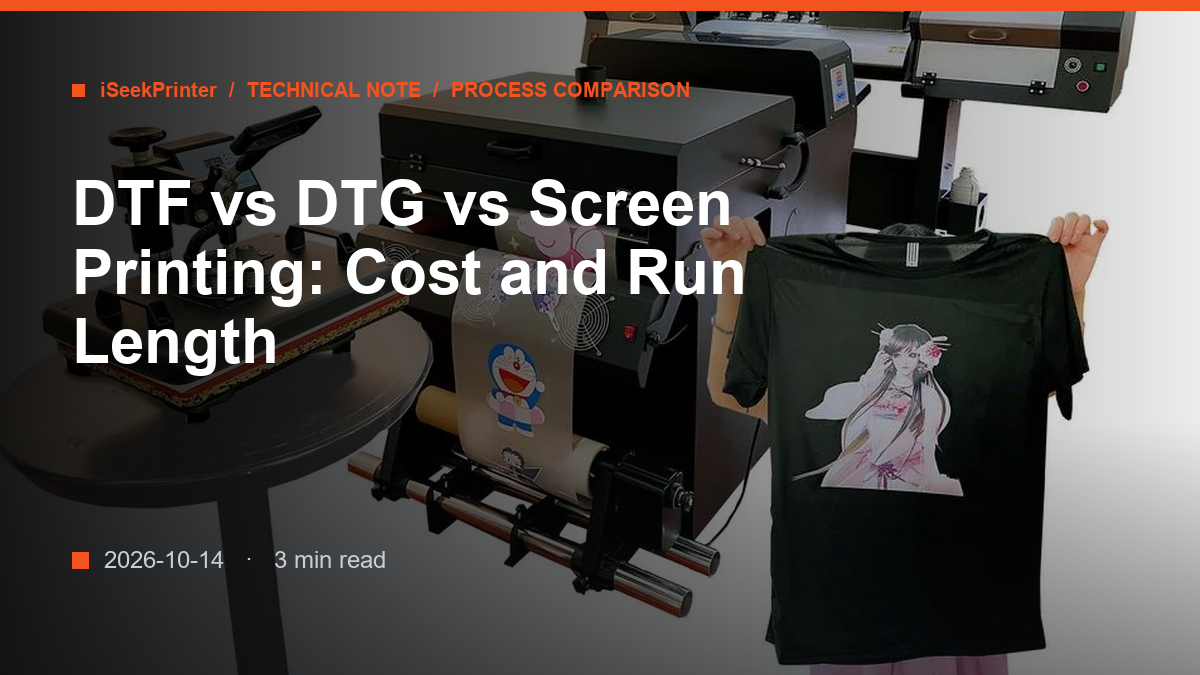
DTF has one cost neither alternative shares: the transfer must be pressed onto the garment as a second operation. That is cheap when a press is already in the workflow, and expensive when it is not, because it adds a machine, a footprint and an operator step to every order.
Choosing for a Mixed Order Book
Between DTG and DTF, the decision usually comes down to fabric mix. A shop printing mostly cotton in light colours can justify DTG and its softer hand. A shop printing dark garments, polyester and blend work is better served by DTF, which needs no pre-treatment and handles dark fabric without an underbase decision on every job.
Rule of thumb: if a design will be reprinted hundreds of times in the same colours, price it as screen work. If it will be printed once, or in five colourways of twelve pieces, price it as digital.
If you already own a heat press, DTF is the lower-friction addition. If your orders are large and repeatable, add screen capacity instead and keep digital for the exceptions.
Comparing machines or planning a production line? Send us your output figures and we will recommend a configuration and quote it.
FAQ
Is DTF cheaper than DTG for small runs?
Usually, because DTF needs no garment pre-treatment and no white-underbase chemistry. Both have low setup cost, so the comparison comes down to consumables and labour, and DTF adds a powdering and pressing step that must be counted.
Can DTF replace screen printing entirely?
No. Screen printing remains cheaper and more durable for long runs of one design, especially in large flat colours. DTF wins on short runs, multi-colour designs and one-offs, where screen setup cannot be justified.
Which process is best for polyester sportswear?
DTF handles polyester and blends well, particularly where dye migration is a risk, and a correctly cured transfer stretches with the fabric. For all-over prints on light polyester, sublimation is usually better because it leaves no hand.