XP600 vs i3200 for DTF: Cost per Print and Service Life
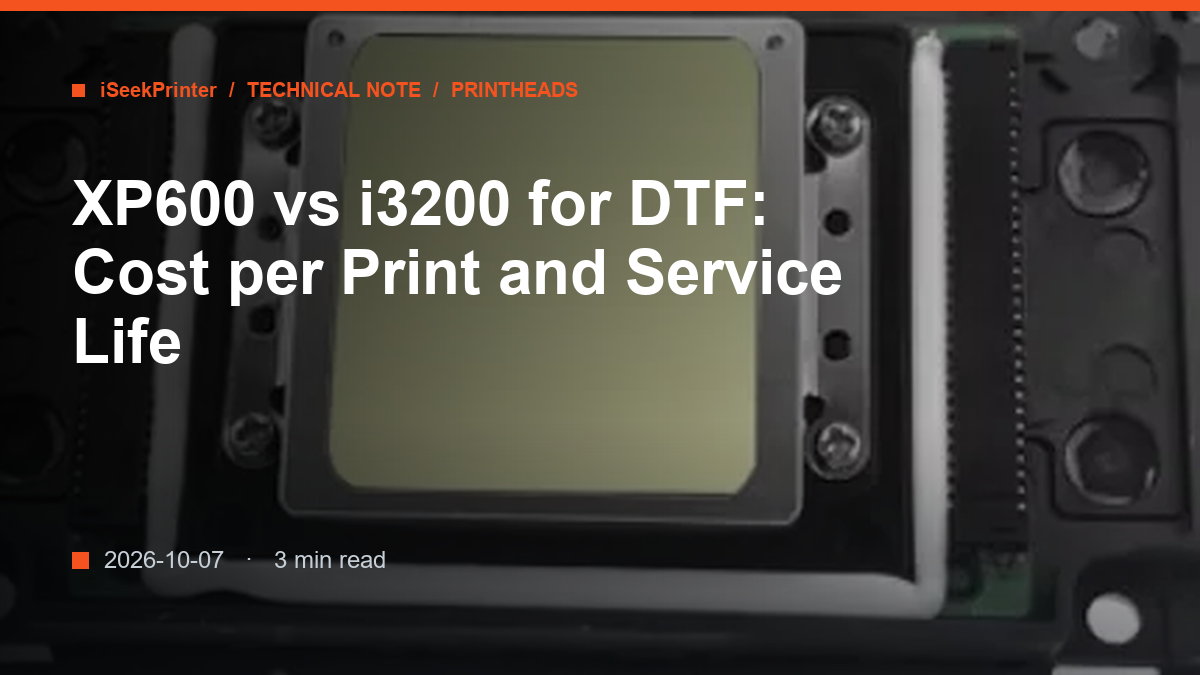
The XP600 versus i3200 decision is the second question most DTF buyers ask, after print width. Both are Epson piezo heads and both print DTF ink reliably. They differ in price, throughput, and how much punishment they take before they need replacing.
Two Heads, Two Cost Structures
An XP600 head costs less to buy and less to replace, which sets the economics of the whole machine: a head failure is an expense rather than an event. That makes XP600 machines the practical choice for shops printing in bursts, for sampling rooms, and for a first DTF printer where volume is not yet proven.
An i3200 head costs more per unit. On a machine that runs most of the working day, the higher throughput spreads that cost over enough output that the head price stops being the dominant number. On a machine that prints three hours a day, it does not.
The comparison that matters is cost per square metre over the life of the head, not the price of the head alone. That needs two numbers most quotes do not give: the current head price and a realistic service interval for your duty cycle.
Speed: Where the Difference Shows
The i3200 prints faster at the same resolution and holds detail better when carriage speed rises. In practice a dual i3200 A1 machine produces more square metres per hour than a dual XP600 A1 at comparable quality, and can hold a higher resolution without dropping to a slow mode.
The speed advantage is worth less than it looks if the bottleneck sits elsewhere. Powdering, curing and pressing are manual or semi-manual steps in most shops, and a printer that outruns the shaker simply creates a queue of wet film.
Service Life and What Shortens It
The i3200 is generally the more durable head under continuous use, which is why it appears on production lines and four-head configurations. The XP600 is not fragile; it is built around a different duty cycle, and it tolerates intermittent work well.
What shortens either head is the same list: dried ink from idle periods, a capping station that no longer seals, wiper blades with a dried ink ridge, and pressure cleaning that damages the nozzle plate. A maintained XP600 outlasts a neglected i3200.
How to Decide
- Choose XP600 if daily output is modest, printing happens in bursts, or the machine is a first step into DTF.
- Choose i3200 if the printer runs most of the day, detail matters at speed, or the machine is part of a multi-head line.
- Choose XP600 if local head availability and replacement cost decide the purchase.
- Choose i3200 only if the shaker and press can absorb the extra output.
One more consideration applies to fleets: keeping one head type across the shop simplifies spare-part stock and training. A shop with three XP600 machines needs one spare head; a mixed fleet needs two, plus two sets of RIP profiles.
Rule of thumb: buy the head type your daily volume can amortise, not the one with the higher number on the specification sheet. A faster head on an idle machine is an expensive spare part.
If you are still sizing the machine, settle print width first. It sets film waste on every job, before head count or head model changes a single figure.
Comparing machines or planning a production line? Send us your output figures and we will recommend a configuration and quote it.
FAQ
Can I upgrade an XP600 machine to i3200 later?
Not as a simple swap. The head, head board, ink path and firmware form a matched set, so changing head type is effectively a different machine build. Decide before you order, or ask what the factory supports for your model.
Does the i3200 use more ink?
Ink consumption is driven by coverage and white-layer thickness more than by head model. A faster head lays down more ink per hour because it prints more square metres, so compare consumption per square metre rather than per day.
Which head is easier to maintain?
The routine is the same for both: daily nozzle checks, a clean capping station, weekly cap and wiper cleaning, and no long idle periods with ink in the lines. Neither head tolerates being left uncapped.